

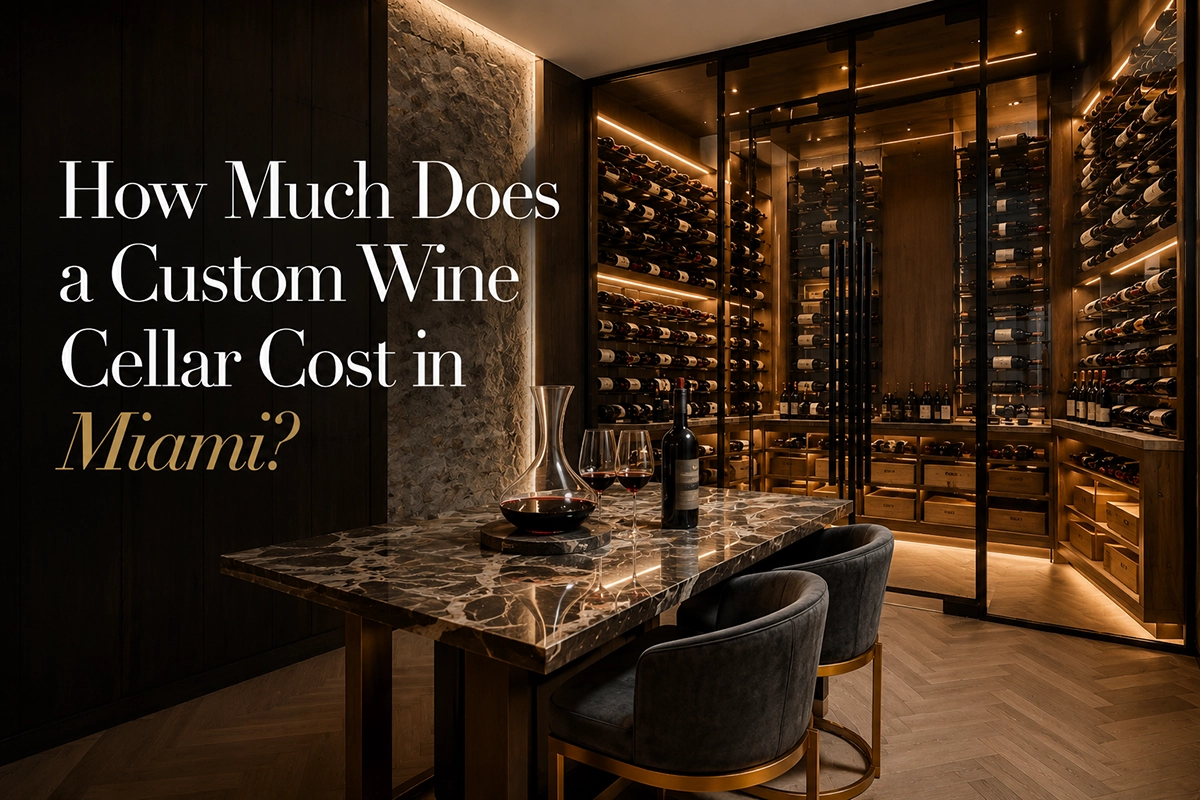
It is one of the first questions every client asks, and the honest answer is the same every time: there is no standard price for a custom wine cellar.
That is not an evasion. It is the truth of what custom means. A wine cellar is not a product pulled from a catalog. It is a work conceived specifically for a space, a client, a vision, and a purpose. The variables that shape its cost are as individual as the project itself, and understanding them is the first step toward making a decision that reflects both your taste and your investment goals.
What follows is the most transparent guide to wine cellar pricing in Miami that you will find, written by a firm that has spent years designing some of the most exclusive private installations in South Florida and beyond.
Explore CellArtus wine cellar services
The First Variable: Purpose
Before materials, before dimensions, before any specification is discussed, the single most defining factor in the cost of a wine cellar is its purpose. And there are three primary categories.
Display-Only Installations
These are wine cellars and wine walls built primarily as architectural and lifestyle features. The wine stored within them is not intended for long-term aging or preservation under strict climate conditions. The purpose is experiential: to create a space that commands attention, elevates the atmosphere of a room, and communicates something meaningful about the environment it inhabits.
Display-only installations do not require climate control, sealed enclosures, vapor barriers, or moisture-resistant components. This removes significant cost from the scope. What remains is pure design: the racking, the materials, the lighting, and the artistry of the installation itself. The investment range for these projects varies widely depending entirely on the scale and ambition of the design.
Storage and Preservation Installations
These are the cellars built for collectors, connoisseurs, and anyone who understands that wine is a living product requiring a carefully controlled environment. Temperature, humidity, light, and vibration all matter. Getting them right is the difference between a bottle that reaches its potential and one that does not.
Temperature-controlled wine cellars require a fundamentally different scope of work: professional cooling systems, closed-cell foam insulation, vapor barriers, sealed enclosures, moisture-resistant materials and components, and waterproof lighting elements throughout. Each of these adds to the investment, and each is essential.
Dual-Purpose Installations
Many of the most compelling projects CellArtus designs serve both functions simultaneously. A wine cellar that is architecturally stunning and fully climate-controlled, that works as a collector’s environment by day and as the defining visual feature of an entertainment space by night. These are the projects that demand the highest level of design intelligence, because every decision must serve both masters: beauty and performance.
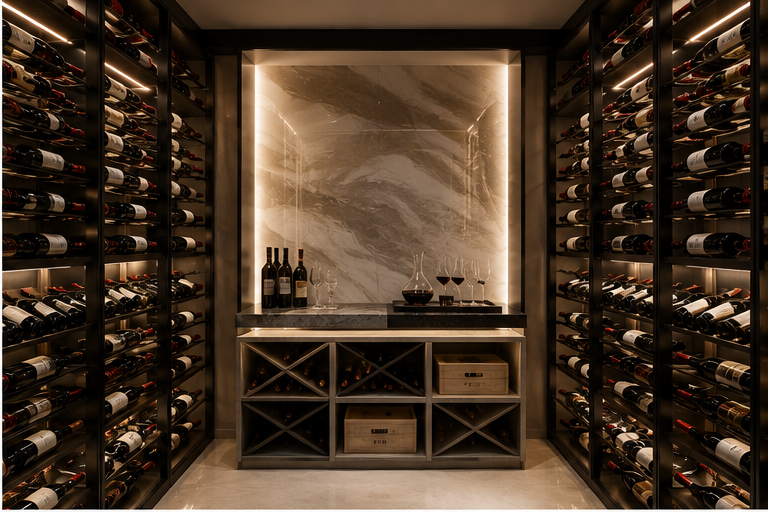
Where the Cellar Lives Changes Everything
A wine cellar does not belong only in a home. CellArtus has designed and installed wine environments across a broad range of settings, and each one presents its own set of requirements, constraints, and creative possibilities.
- Private residences and luxury homes: the most common setting, ranging from integrated living room features to full dedicated cellar rooms
- Yachts and marine environments: one of the most technically demanding settings, requiring materials and finishes that perform in a marine environment and designs that account for motion, space constraints, and humidity levels that exceed even Miami’s conditions on land
- Restaurants and hospitality venues: where the wine cellar becomes part of the guest experience, often serving as a focal point of the dining room or a private tasting environment
- Entertainment spaces and man caves: where the cellar is the centerpiece of a room designed entirely around experience and impression
- Collector environments and wine storage facilities: where volume, access, and preservation precision drive the brief
- Condominium and high-rise interiors: where space is often more limited and structural constraints demand creative problem-solving
- Wine bars, tasting rooms, and lifestyle retail environments: where the cellar serves as both functional storage and a brand statement
Each setting brings a different set of technical and design requirements. A marine installation demands corrosion-resistant hardware, sealed components, and materials that hold up under constant humidity. A restaurant cellar must balance preservation with visibility and accessibility. A residential installation in a high-rise may require custom structural solutions before a single rack is placed. The setting is never neutral, and it always influences the final investment.
The Enclosure: How the Cellar Is Defined in Space
The physical form of the cellar, how it is enclosed and how it relates to the space around it, is one of the most significant cost drivers in any project.
Open Wine Wall or Display Rack
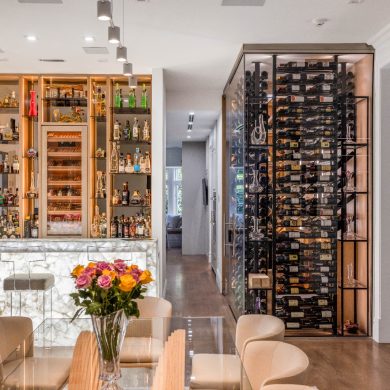
An exposed wine wall with custom racking and integrated lighting, built directly into or against a wall without enclosure. The most accessible entry point from a cost perspective, and when executed with the right materials and design vision, one of the most visually powerful.
Partially Enclosed or Three-Wall Cellar with a Single Door
A more contained installation that begins to define the cellar as its own space. Adds cost through additional structure, a door specification, and often more complex lighting and racking layouts.
Fully Enclosed Glass Cellar with Framed Insulated Panels
A complete architectural enclosure using double or triple-pane insulated glass set within a custom metal frame. The ideal specification for temperature-controlled environments in Miami’s climate, delivering superior thermal performance and a commanding visual presence. The frame profile, finish, and glass specification all influence cost.
Fully Enclosed Frameless Glass Cellar
A seamless enclosure using heavy half-inch tempered glass sealed with clear gaskets and minimal hardware. No visible frames, no interrupted sightlines. A frameless cellar requires a more powerful cooling system to compensate for the reduced insulation value of single-pane glass, and it demands a consistently controlled ambient room environment. The aesthetic result is unmatched in its purity, and the cost reflects the precision required to execute it correctly.
Full Traditional Enclosed Wine Room
A dedicated room with insulated walls on all sides, a sealed entry, and complete climate control. The most comprehensive and technically demanding format, and the one that offers the greatest level of preservation performance. This is where the full scope of structural preparation, insulation, vapor barriers, cooling systems, and interior finishes converges into a single investment.
Materials: Where Art and Investment Meet
No element of a wine cellar communicates its quality more immediately than the materials from which it is made. And no element creates a wider range in pricing. At CellArtus, material selection is a design conversation, not a checklist. Every choice is made in relation to the others, building a composition that is coherent, refined, and specific to the project.
Metal Structures and Hardware
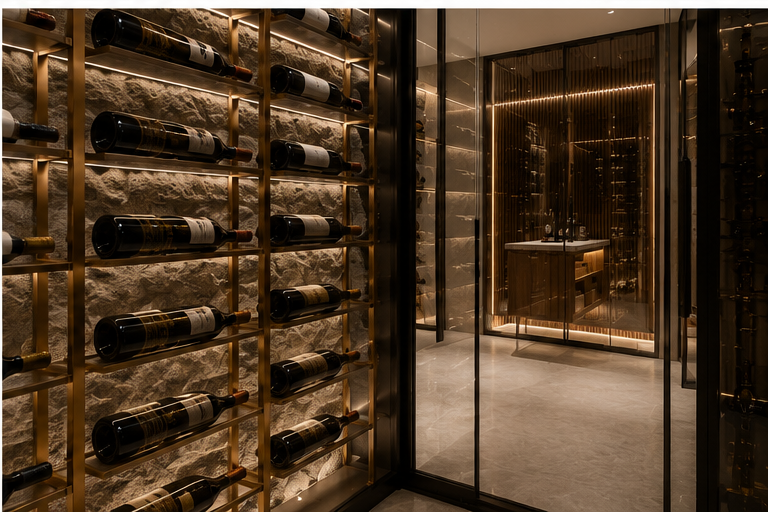
The difference between a standard black powder-coated rack and a full brass structure is not simply aesthetic. It is a statement about permanence, about craft, and about the kind of space the client is creating. Brushed finishes read differently from polished ones. Matte black reads differently from antique bronze. Polished chrome is an entirely different conversation from satin nickel. Every finish has a cost, and the more bespoke the specification, the greater the investment.
Stone and Decorative Surfaces
Stone selection alone can transform the character of a wine cellar entirely. A traditional limestone or slate reads one way. A Cristalo quartzite or an Anymix composite with backlit illumination reads another. Backlit illuminated stone, where light passes through the surface to create a luminous, translucent effect, is one of the most dramatic material choices available in wine cellar design and one of the most impactful on pricing. The stone species, the slab thickness, the fabrication complexity, and the integration of lighting behind it all contribute to the final cost.
Wood: Veneer, Solid, and Cabinetry
Wood is the soul of most wine cellars, and the range of options is significant. A wood veneer finish applied over an engineered substrate reads beautifully in photographs but behaves differently over time than solid wood. Solid walnut or white oak millwork, cut, joined, and finished by hand, carries a different cost and a different permanence. Cabinetry with laminated finishes offers durability and consistency. Custom carved or book-matched panels are in a category of their own. The wood specification is never a minor decision, and in a temperature-controlled cellar, it must also be evaluated for how it performs under controlled humidity conditions.
Lighting: Technology, Environment, and Effect
Lighting in a wine cellar is one of the most nuanced and frequently underestimated cost variables in the entire project. The difference between a single-color LED strip with basic dimming and a full RGB CCT system that adjusts color temperature, hue, and intensity independently is significant, both in the experience it creates and in the investment it requires.
In a temperature-controlled environment, all lighting components must be waterproof and rated for use in humid conditions. This affects the specification of every fixture, every strip, every driver, and every control system. In a display-only installation without climate control, standard components can be used, which reduces cost but also limits the range of effects available.
The lighting design itself, the placement of concealed channels, the decision to backlight stone or glass shelving, the integration of accent spots with ambient fills, is a discipline that CellArtus approaches with the same rigor as any other element of the project. A cellar with exceptional lighting design is one that reveals itself differently throughout the day and creates an experience that is felt as much as seen.
Scope of Involvement: How Far the Project Goes
One of the most significant and least discussed variables in wine cellar pricing is the degree to which the space itself must be transformed before the cellar can be built.
Some clients come to CellArtus with a space that is essentially ready: the dimensions are right, the structural elements are in place, and the installation can proceed with minimal intervention. Other projects require the space to be reimagined entirely before a single rack is placed: walls removed or added, structural reinforcement, electrical upgrades, AC modifications, flooring changes, and coordination with other trades across the broader renovation.
The deeper CellArtus’s involvement in the preparation and transformation of a space, the more comprehensive the investment. This is not a cost to be minimized. It is the foundation on which the cellar is built, and it is what separates an installation that performs flawlessly for decades from one that compromises over time.
The CellArtus Standard: Exclusivity, Art, and Investment Value
CellArtus is not a company that builds wine cellars at volume. It is a design firm built over years of exclusive work in private residences, yachts, hospitality environments, and collector spaces, always at the highest level of craft and design intentionality.
Every cellar CellArtus designs is unique. Not in the marketing sense of the word, but in the literal one: no two projects share a design, a material combination, or a layout. Each installation is conceived from scratch for the client, the space, and the vision. When a CellArtus cellar is complete, it is the only one of its kind in the world.
That exclusivity has a compounding effect on value. A wine cellar that is beautifully designed, impeccably built, and truly irreplaceable appreciates in significance over time. The investment a client makes today, in materials, in craft, in design, reflects not only the current cost of those elements but the growing recognition of CellArtus as a firm whose work defines a standard in the field. As that recognition grows, the value of every project already built grows with it.
This is what separates a CellArtus wine cellar from any other. It is not simply a feature added to a space. It is a work of art installed within it, one that will be admired, discussed, and valued for as long as it stands.
A Realistic Pricing Reference for Miami
Because every project is genuinely different, there is no fixed starting price for a CellArtus wine cellar. What we can offer is a realistic orientation based on current project costs in the Miami market, understanding that the final investment for any given project depends on the full combination of purpose, setting, enclosure type, materials, lighting, and scope.
- Display-only wine wall or open rack installation: driven entirely by design complexity and material selection, with no fixed floor
- Small turnkey temperature-controlled wine room, up to approximately 300 bottles, with glass enclosure and essential finishes: starting around $50,000
- Mid-range turnkey temperature-controlled cellar, 300 to 500 bottles, luxury materials including wood millwork, stone accents, and custom metal structures in specialty finishes: approximately $85,000 to $100,000 and above
- Full architectural temperature-controlled installation, larger footprint, premium materials throughout, statement glass enclosure, high-capacity cooling system: $100,000 and above, shaped by cubic footage, enclosure complexity, material specifications, and site conditions
These are reference points, not quotes. Every CellArtus project begins with a design consultation in which the full scope is understood before any number is discussed. That conversation is where the real project begins.
Begin the Conversation
If you are considering a wine cellar for your home, yacht, restaurant, or any space where design and experience matter, CellArtus is the firm to call. We work with a select group of clients each year, and every project we take on receives the full depth of our design attention, technical expertise, and artistic vision.
The investment you make in a CellArtus wine cellar is one that grows in value over time. There will never be another one exactly like it.




Add comment